
The white stork (Ciconia ciconia) is a large bird in the stork family, Ciconiidae. Its plumage is mainly white, with black on the bird's wings. Adults have long red legs and long pointed red beaks, and measure on average 100–115 cm (39–45 in) from beak tip to end of tail, with a 155–215 cm (61–85 in) wingspan. The two subspecies, which differ slightly in size, breed in Europe (north to Finland), northwestern Africa, southwestern Asia (east to southern Kazakhstan) and southern Africa. The white stork is a long-distance migrant, wintering in Africa from tropical Sub-Saharan Africa to as far south as South Africa, or on the Indian subcontinent. When migrating between Europe and Africa, it avoids crossing the Mediterranean Sea and detours via the Levant in the east or the Strait of Gibraltar in the west, because the air thermals on which it depends for soaring do not form over water. A carnivore, the white stork eats a wide range of animal prey, including insects, fish, amphibians, reptiles, small mammals and small birds. It takes most of its food from the ground, among low vegetation, and from shallow water. It is a monogamous breeder, but does not pair for life. Both members of the pair build a large stick nest, which may be used for several years. Each year the female can lay one clutch of usually four eggs, which hatch asynchronously 33–34 days after being laid. Both parents take turns incubating the eggs and both feed the young. The young leave the nest 58–64 days after hatching, and continue to be fed by the parents for a further 7–20 days. The white stork has been rated as least concern by the International Union for Conservation of Nature (IUCN). It benefited from human activities during the Middle Ages as woodland was cleared, but changes in farming methods and industrialisation saw it decline and disappear from parts of Europe in the 19th and early 20th centuries. Conservation and reintroduction programs across Europe have resulted in the white stork resuming breeding in the Netherlands, Belgium, Switzerland, Sweden and the United Kingdom. It has few natural predators, but may harbour several types of parasite; the plumage is home to chewing lice and feather mites, while the large nests maintain a diverse range of mesostigmatic mites. This conspicuous species has given rise to many legends across its range, of which the best-known is the story of babies being brought by storks.
White Stork

Animals Of The Jungle
for Animals Of The Jungle in Disney's Jungle Book II
Suggested by adrianabengozarlopez
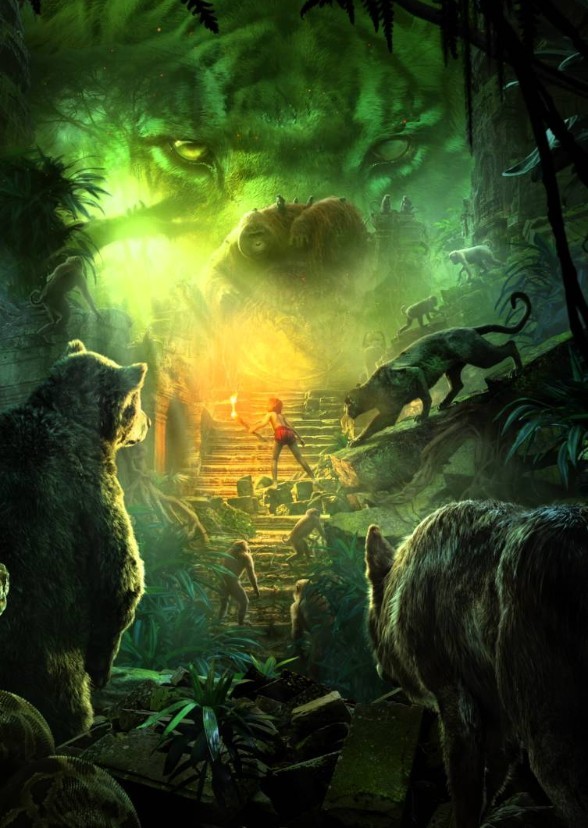
Mowgli is 15 years old and is still living in the jungle with his wolf family and Baloo, the bear and Bagheera, the black panther. Raksha is still the leader of the wolf pack, Mowgli's wolf siblings are all grown, Sura, Lura, Akru and Grey. One day, Baloo injured his paw so Mowgli went off to get some leaves from a medical plant to heal it. However, Mowgli unexpected came across a young girl name Kitty Brydon, who is on her first journey to travel to India. It was Mowgli's first time to ever meet a human girl before, even though he didn't understand man's language. Kitty walked back to other travelers, and Mowgli traveled back to bring the medial plant to heal Baloo, but he grew a new feeling for Kitty as he couldn't stop thinking about her.




