Archaeopteryx (/ˌɑːrkiːˈɒptərɪks/ "old wing"), sometimes referred to by its German name, Urvogel ("original bird" or "first bird"), is a genus of bird-like dinosaurs. The name derives from the ancient Greek ἀρχαῖος (archaīos), meaning "ancient", and πτέρυξ (ptéryx), meaning "feather" or "wing". Between the late 19th century and the early 21st century, Archaeopteryx was generally accepted by palaeontologists and popular reference books as the oldest known bird (member of the group Avialae).[2] Older potential avialans have since been identified, including Anchiornis, Xiaotingia, and Aurornis.[3] Archaeopteryx lived in the Late Jurassic around 150 million years ago, in what is now southern Germany, and also Portugal, during a time when Europe was an archipelago of islands in a shallow warm tropical sea, much closer to the equator than it is now. Similar in size to a Eurasian magpie, with the largest individuals possibly attaining the size of a raven,[4] the largest species of Archaeopteryx could grow to about 0.5 m (1 ft 8 in) in length. Despite their small size, broad wings, and inferred ability to fly or glide, Archaeopteryx had more in common with other small Mesozoic dinosaurs than with modern birds. In particular, they shared the following features with the dromaeosaurids and troodontids: jaws with sharp teeth, three fingers with claws, a long bony tail, hyperextensible second toes ("killing claw"), feathers (which also suggest warm-bloodedness), and various features of the skeleton.[5][6] These features make Archaeopteryx a clear candidate for a transitional fossil between non-avian dinosaurs and birds.[7][8] Thus, Archaeopteryx plays an important role, not only in the study of the origin of birds, but in the study of dinosaurs. It was named from a single feather in 1861,[9] the identity of which has been controversial.[10][11] That same year, the first complete specimen of Archaeopteryx was announced. Over the years, ten more fossils of Archaeopteryx have surfaced. Despite variation among these fossils, most experts regard all the remains that have been discovered as belonging to a single species, although this is still debated. Archaeopteryx was long considered to be the beginning of the evolutionary tree of birds. It has qualities that helped define what it is like to be a bird, such as its long, powerful front limbs. However, in recent years, the discovery of several small, feathered dinosaurs has created a mystery for paleontologists, raising questions about which animals are the ancestors of modern birds and which are their relatives.[12] Most of these eleven fossils include impressions of feathers. Because these feathers are of an advanced form (flight feathers), these fossils are evidence that the evolution of feathers began before the Late Jurassic.[13] The type specimen of Archaeopteryx was discovered just two years after Charles Darwin published On the Origin of Species. Archaeopteryx seemed to confirm Darwin's theories and has since become a key piece of evidence for the origin of birds, the transitional fossils debate, and confirmation of evolution.
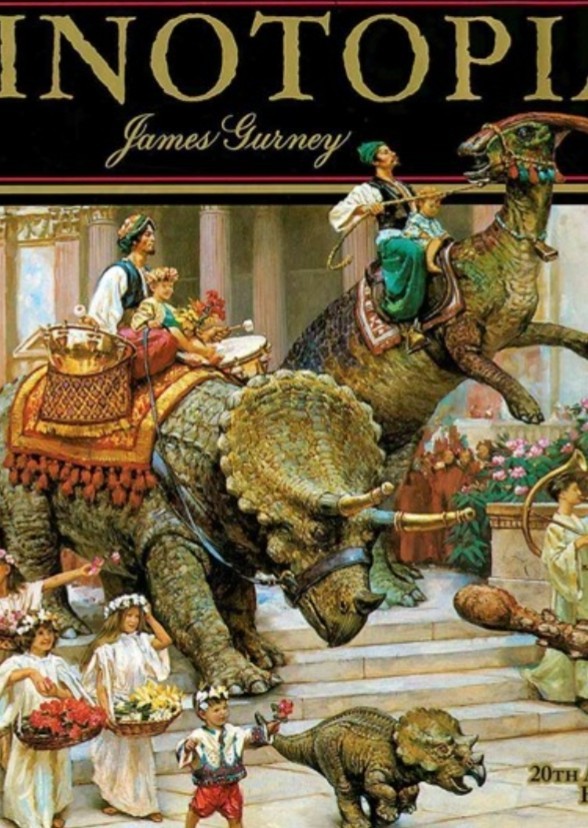
In 1862 Arthur Denison and his son William Denison end up shipwrecked following a storm that washed them up on a mysterious island where Dinosaurs and Humans coexist with each other along with prehistoric animals and both father and son try and learn to adjust to their new environment as well going on several adventures