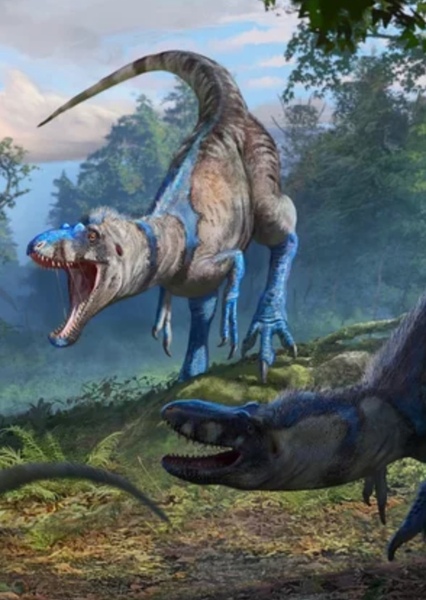
Iguanodon (/ɪˈɡwɑːnədɒn/ i-GWAH-nə-don; meaning "iguana-tooth"), named in 1825, is a genus of ornithopod dinosaur that existed roughly halfway between the first of the swift bipedal hypsilophodontids of the mid-Jurassic and the duck-billed dinosaurs of the late Cretaceous. While many species have been classified in the genus Iguanodon, dating from the late Jurassic Period to the early Cretaceous Period of Asia, Europe, and North America, taxonomic revision in the early 21st century has defined Iguanodon to be based on one well-substantiated species: I. bernissartensis, which lived from the late Barremian to the earliest Aptian ages[4] (Early Cretaceous) in Belgium, Spain, Germany, England, Portugal and possibly elsewhere in Europe, between about 126 and 122 million years ago. Iguanodon were large, bulky herbivores. Distinctive features include large thumb spikes, which were possibly used for defense against predators, combined with long prehensile fifth fingers able to forage for food. The genus was named in 1825 by English geologist Gideon Mantell but discovered by William Harding Bensted, based on fossil specimens found in England and was given the species name I. anglicus. Iguanodon was the second type of dinosaur formally named based on fossil specimens, after Megalosaurus. Together with Megalosaurus and Hylaeosaurus, it was one of the three genera originally used to define Dinosauria. The genus Iguanodon belongs to the larger group Iguanodontia, along with the duck-billed hadrosaurs. The taxonomy of this genus continues to be a topic of study as new species are named or long-standing ones reassigned to other genera. In 1878 new, far more complete remains of Iguanodon were discovered in Belgium and studied by Louis Dollo. These were given the new species I. bernissartensis. In the early 21st century it became understood that the remains referred to Iguanodon in England belonged to four different species (including I. bernissartensis) that were not closely related to each other, which were subsequently split off into Mantellisaurus, Barilium and Hypselospinus. It was also found that the originally described type species of Iguanodon, I. anglicus was a nomen dubium, and not valid. Thus the name "Iguanodon" became fixed around the well known species based primarily on the Belgian specimens. Scientific understanding of Iguanodon has evolved over time as new information has been obtained from fossils. The numerous specimens of this genus, including nearly complete skeletons from two well-known bone beds, have allowed researchers to make informed hypotheses regarding many aspects of the living animal, including feeding, movement, and social behaviour. As one of the first scientifically well-known dinosaurs, Iguanodon has occupied a small but notable place in the public's perception of dinosaurs, its artistic representation changing significantly in response to new interpretations of its remains.
Iguanodon

Prehistoric Creatures
for Prehistoric Creatures in Dino-Riders
Suggested by alecgroskreutz1

The Valorians were a species of peaceful humanoids that lived on the planet Valoria until they were invaded by the predatory Rulons. A group of Valorians lead by Questar attempted to escape the Rulon invasion using a spaceship equipped with their "Space Time Energy Projector" (S.T.E.P.); however, something went wrong. They were sent back in time and space, to the planet Earth 65 million years back to the age of the dinosaurs. Unknown to them, the Rulon flagship, the Dreadlock, locked in with a tractor beam, was also sent back through time when the S.T.E.P. was activated. After successfully landing on prehistoric Earth, the Valorians used their AMP ("Amplified Mental Projector") necklaces to telepathically communicate with the dinosaurs they encountered and eventually befriended them. On the other hand, the Rulons - led by the warlord Krulos - used brainwashing devices known as brain-boxes to control dinosaurs for their own needs. The Rulons then launched an attack on the Valorians, who called upon their dinosaur friends to assist them in fighting back. After ultimately defeating the Rulons, the Valorians renamed themselves Dino-Riders.