
Died at 90
male
Dennis Lee Hopper (May 17, 1936 – May 29, 2010) was an American actor, filmmaker and artist. As a young man, Hopper became interested in acting and eventually became a student of the Actors' Studio. He made his first television appearance in 1954, and appeared in two films featuring James Dean, Rebel Without a Cause (1955) and Giant (1956). During the next 10 years, Hopper appeared frequently on television in guest roles, and by the end of the 1960s had played supporting roles in several films. He directed and starred in Easy Rider (1969), winning an award at the Cannes Film Festival and was nominated for an Academy Award for Best Original Screenplay as co-writer. "With its portrait of counterculture heroes raising their middle fingers to the uptight middle-class hypocrisies, Easy Rider became the cinematic symbol of the 1960s, a celluloid anthem to freedom, macho bravado and anti-establishment rebellion." Film critic Matthew Hays notes that "no other persona better signifies the lost idealism of the 1960s than that of Dennis Hopper." He was unable to build on his success for several years, until a featured role in Apocalypse Now (1979) brought him attention. He subsequently appeared in Rumble Fish (1983) and The Osterman Weekend (1983), and received critical recognition for his work in Blue Velvet and Hoosiers, with the latter film garnering him an Academy Award nomination for Best Supporting Actor. He directed Colors (1988) and played the villain in Speed (1994). Hopper's later work included a leading role in the television series Crash. Hopper's last performance was filmed just before his death: The Last Film Festival, slated for a 2011 release. Hopper was also a prolific and acclaimed photographer, a profession he began in the 1960s. From Wikipedia, the free encyclopedia
Dennis Hopper

Lex Luthor
for Lex Luthor in David Lynch's Superman (1994)
Suggested by iceber
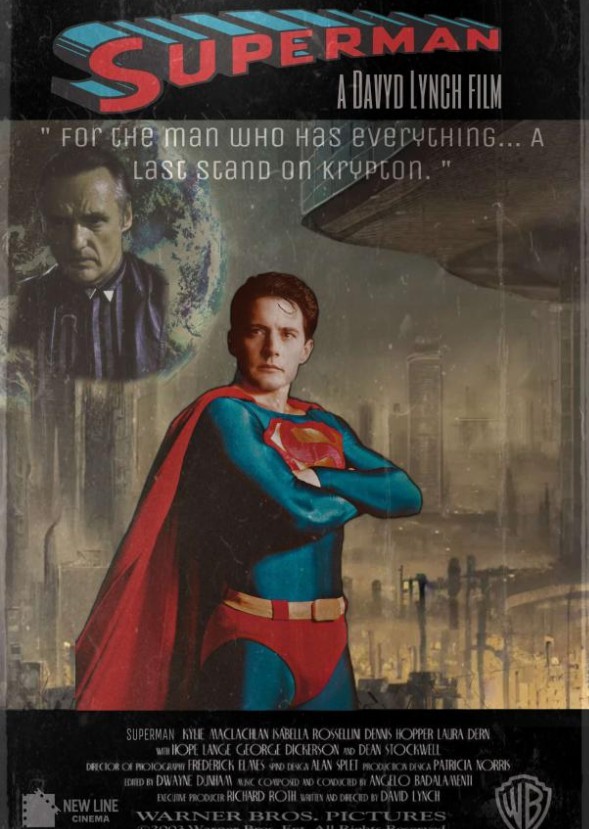
After the success of Tim Burton's Batman and Batman Returns, Warner Brothers decided it was time to reboot Superman. Initially, they wanted Burton to do Superman as well, but the project fell through. Eventually, WB sought out David Lynch following the success of Twin Peaks. At the time of release, it was polarizing to mainstream audiences. Lynch didn't hold back with his trademark surrealist style, providing a fresh take on the modern myth. Warner Brothers, unhappy with the film's reception, cancelled its planned sequel and once again the character of Superman was shelved from the big screen for a number of years. In recent years, however, the film has gained a cult following and reappraisal from many, considering it to be a great deconstruction of the core themes of Superman.

