Age: 47
female
Mary Rose Byrne (born 24 July 1979) is an Australian actress. She made her screen debut in the film Dallas Doll (1994), and continued to act in Australian film and television throughout the 1990s. She obtained her first leading film role in The Goddess of 1967 (2000), which brought her the Volpi Cup for Best Actress and made the transition to Hollywood in the small role of Dormé in Star Wars: Episode II – Attack of the Clones (2002), followed by larger parts in Troy (2004), 28 Weeks Later (2007), and Knowing (2009). Byrne appeared as Ellen Parsons in the legal thriller series Damages (2007–2012), which earned her two Golden Globe Awards nominations and two Primetime Emmy Award nominations. Get Him to the Greek (2010) and Bridesmaids (2011) established her as a comedic actress, in addition to the dramas and thrillers in which she continues to appear. She has since starred in a number of commercially successful comedies and dramas, including Insidious (2010) and its sequel Insidious: Chapter 2 (2013), X-Men: First Class (2011) and its sequel X-Men: Apocalypse (2016), Annie (2014), as well as Peter Rabbit (2018) and its sequel Peter Rabbit 2: The Runaway (2021). Byrne also portrayed Gloria Steinem in the miniseries Mrs. America (2020) and led the comedy series Physical (2021–2023) and Platonic (2023). Byrne has been in relationship with American actor Bobby Cannavale since 2012 and they have two sons. And she is the sister-in-law of New Zealand actress Rose McIver from her brother's marriage.
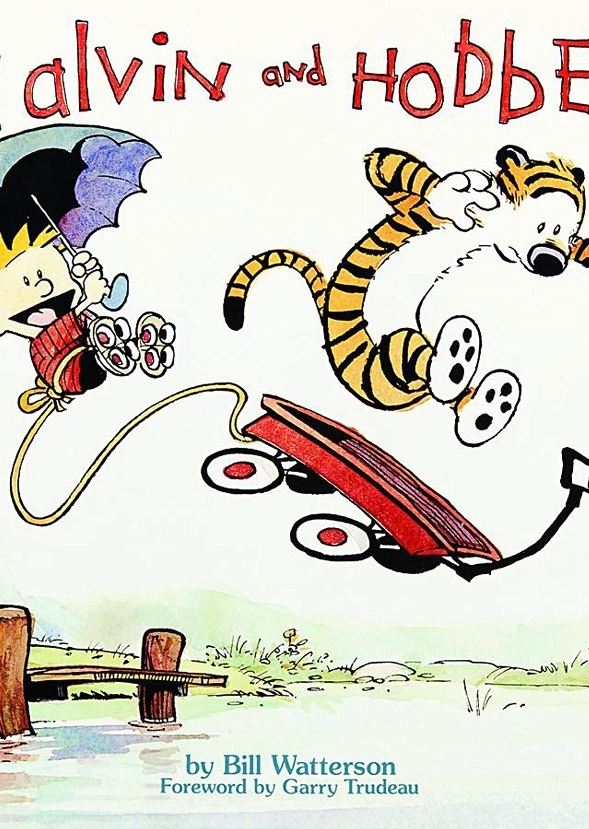
Calvin and Hobbes follows the humorous antics of the title characters: Calvin, a mischievous and adventurous six-year-old boy; and his friend Hobbes, a sardonic tiger. Set in the suburban United States of the 1980s and 1990s, the strip depicts Calvin's frequent flights of fancy and friendship with Hobbes. It also examines Calvin's relationships with his long-suffering parents and with his classmates, especially his neighbor Susie Derkins. Hobbes's dual nature is a defining motif for the strip: to Calvin, Hobbes is a living anthropomorphic tiger, while all the other characters seem to see Hobbes as an inanimate stuffed toy, though Watterson has not clarified exactly how Hobbes is perceived by others, or whether he is real or an imaginary friend. Though the series does not frequently mention specific political figures or ongoing events, it does explore broad issues like environmentalism, public education, and philosophical quandaries.