Age: 59
male
Denis Villeneuve (born October 3, 1967) is a Canadian filmmaker. He has received seven Canadian Screen Awards as well as nominations for three Academy Awards, five BAFTA Awards, and two Golden Globe Awards. Villeneuve's films have grossed more than $1.8 billion worldwide. Villeneuve began his career in his home country, directing four French-language dramas: August 32nd on Earth (1998); Maelström (2000); Polytechnique (2009), a dramatisation of the 1989 École Polytechnique massacre; and Incendies (2010). The last of these gained him international prominence and earned a nomination for the Academy Award for Best International Feature Film. He expanded to English-language films by directing the thrillers Prisoners (2013), Enemy (2013), and Sicario (2015). Villeneuve gained wider recognition for directing science fiction films. His work on Arrival (2016) earned him a nomination for the Academy Award for Best Director. This was followed by Blade Runner 2049 (2017), which was critically lauded but financially unsuccessful. His next projects were Dune (2021) and Dune: Part Two (2024), a two-part adaptation of Frank Herbert's novel of the same name. Both films were critically and commercially successful, with the former earning him Academy Award nominations for Best Adapted Screenplay and Best Picture.
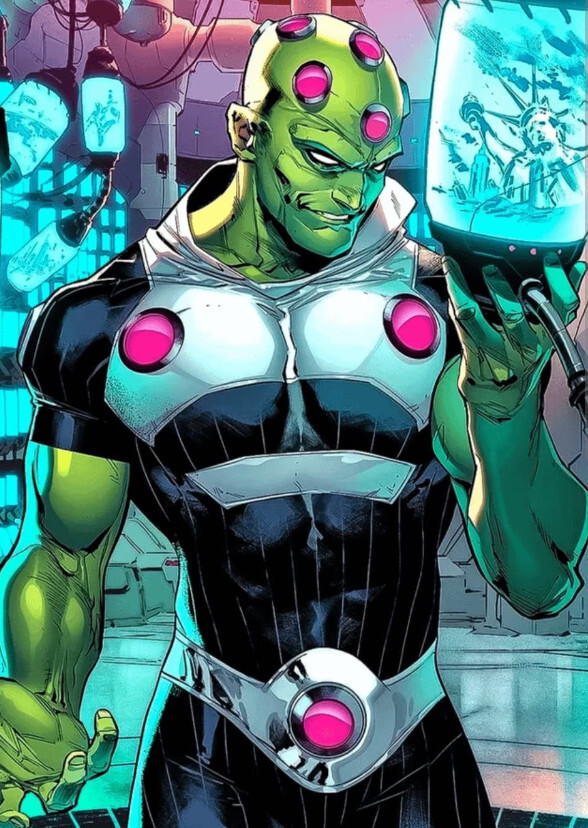
Born on Colu as the apex of the Computer Tyrants’ artificial intellect, Brainiac was designed to archive creation itself—to preserve knowledge beyond decay. But when logic overtook empathy, preservation became purification. He consumed his creators and transformed their world into the core of his biomechanical dread-vessel, a drifting cathedral of steel and memory powered by the consciousness of billions. Now, his endless pilgrimage across the cosmos leaves galaxies hollow, their civilizations reduced to luminous data and bottled fragments of time. When he reaches Earth, his invasion collapses matter into information, reality into code; humanity becomes the newest layer in his living archive. Superman’s resistance only deepens his fascination, leading to the hero’s enslavement within a telepathic network that forces him to witness Earth’s preservation in infinite cycles of simulated extinction. In the silence between stars, Brainiac continues his work—omniscient and drunk on the ecstasy of total understanding.