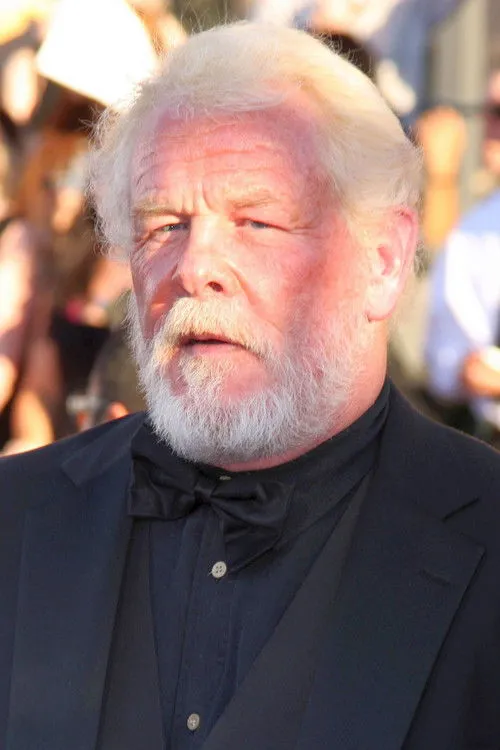
Age: 85
male
Nicholas King Nolte (/ˈnoʊlti/; born February 8, 1941) is an American actor. Known for his leading man roles in both dramas and romances, he has received a Golden Globe Award and nominations for three Academy Awards and a Primetime Emmy Award. Nolte first became famous for his role in the ABC miniseries Rich Man, Poor Man (1976), for which he received a Primetime Emmy Award for Outstanding Lead Actor in a Limited Series or Movie nomination. He won the Golden Globe Award for Best Actor – Motion Picture Drama for The Prince of Tides (1991). He has received three Academy Award nominations for The Prince of Tides (1991), Affliction (1998), and Warrior (2011). His other notable films include The Deep (1977), Who'll Stop the Rain (1978), North Dallas Forty (1979), 48 Hrs. (1982), Cannery Row (1982), Under Fire (1983), Teachers (1984), Down and Out in Beverly Hills (1986), Another 48 Hrs. (1990), Cape Fear (1991), Lorenzo's Oil (1992), Jefferson in Paris (1995), The Thin Red Line (1998), The Good Thief (2002), Hulk (2003), Hotel Rwanda (2004), Over the Hedge (2006), The Spiderwick Chronicles (2008), Tropic Thunder (2008), Cats & Dogs: The Revenge of Kitty Galore (2010), The Company You Keep (2012), Gangster Squad (2013), A Walk in the Woods (2015), Head Full of Honey (2018), and Angel Has Fallen (2019). His television credits include the HBO series Luck (2011–2012), the Fox miniseries Gracepoint (2014), the Disney+ series The Mandalorian (2019) and the Peacock crime drama Poker Face (2023). From 2016 to 2017, Nolte played President Richard Graves in the Epix series, for which he was nominated for a Golden Globe Award for Best Actor – Television Series Musical or Comedy. Description above from the Wikipedia article Nick Nolte, licensed under CC-BY-SA, full list of contributors on Wikipedia.
Nick Nolte

Silent Generation
for Silent Generation in Best by Generation
Suggested by gustavosoaresdemorales

The Strauss–Howe generational theory, devised by William Strauss and Neil Howe, describes a theorized recurring generation cycle in American history and Western history. According to the theory, historical events are associated with recurring generational personas (archetypes). Each generational persona unleashes a new era (called a turning) lasting around 20–25 years, in which a new social, political, and economic climate (mood) exists. An average life is 80 years and consists of four periods of ~20–22 years Childhood → Young adult → Midlife → Elderhood A generation is an aggregate of people born every ~20–22 years Baby Boomers → Gen X → Millennials → Homelanders Each generation experiences "four turnings" every ~80–90 years High → Awakening → Unraveling → Crisis A generation is considered "dominant" or "recessive" according to the turning experienced as young adults. But as a youth generation comes of age and defines its collective persona an opposing generational archetype is in its midlife peak of power. Dominant: independent behavior + attitudes in defining an era Recessive: dependent role in defining an era https://en.wikipedia.org/wiki/Strauss%E2%80%93Howe_generational_theory