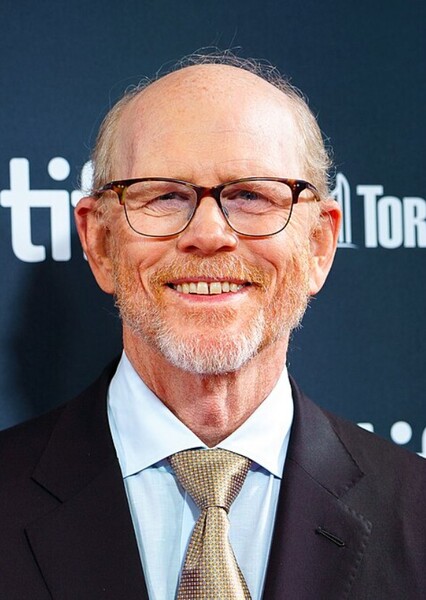
Age: 72
male
Ronald William Howard (born March 1, 1954) is an American filmmaker and actor. Howard first came to prominence as a child actor, guest-starring in several television series, including an episode of The Twilight Zone. He gained national attention for playing young Opie Taylor, the son of Sheriff Andy Taylor (played by Andy Griffith) in the sitcom The Andy Griffith Show from 1960 through 1968. During this time, he also appeared in the musical film The Music Man (1962), a critical and commercial success. He was credited as Ronny Howard in his film and television appearances from 1959 to 1973. Howard was cast in one of the lead roles in the coming-of-age film American Graffiti (1973), which received widespread acclaim and became one of the most profitable films in history. The following year, Howard became a household name for playing Richie Cunningham in the sitcom Happy Days, a role he would play from 1974 through 1984. Howard continued appearing in films during this time, such as the western film The Shootist (1976) and the comedy film Grand Theft Auto (1977), which also marked his directorial debut. In 1984, Howard left Happy Days to focus on directing, producing and occasionally writing variety films and television series. His films include the science-fiction/fantasy Cocoon (1985), the fantasy Willow (1988), the thriller Backdraft (1991), the historical docudrama Apollo 13 (1995), the Christmas comedy How the Grinch Stole Christmas (2000), the biographical drama A Beautiful Mind (2001), the biographical sports drama Cinderella Man (2005), the thriller The Da Vinci Code (2006), the historical drama Frost/Nixon (2008), Solo: A Star Wars Story (2018), and the documentary Pavarotti (2019). For A Beautiful Mind, Howard won the Academy Award for Best Director and Academy Award for Best Picture. He was nominated again for the same awards for Frost/Nixon. In 2003, Howard was awarded the National Medal of Arts. He was inducted into the Television Hall of Fame in 2013. Howard has two stars on the Hollywood Walk of Fame for his contributions in the television and motion pictures industries.
Ron Howard

Baby Boomers
for Baby Boomers in Best by Generation
Suggested by gustavosoaresdemorales

The Strauss–Howe generational theory, devised by William Strauss and Neil Howe, describes a theorized recurring generation cycle in American history and Western history. According to the theory, historical events are associated with recurring generational personas (archetypes). Each generational persona unleashes a new era (called a turning) lasting around 20–25 years, in which a new social, political, and economic climate (mood) exists. An average life is 80 years and consists of four periods of ~20–22 years Childhood → Young adult → Midlife → Elderhood A generation is an aggregate of people born every ~20–22 years Baby Boomers → Gen X → Millennials → Homelanders Each generation experiences "four turnings" every ~80–90 years High → Awakening → Unraveling → Crisis A generation is considered "dominant" or "recessive" according to the turning experienced as young adults. But as a youth generation comes of age and defines its collective persona an opposing generational archetype is in its midlife peak of power. Dominant: independent behavior + attitudes in defining an era Recessive: dependent role in defining an era https://en.wikipedia.org/wiki/Strauss%E2%80%93Howe_generational_theory