
Age: 56
male
Sir Steve Rodney McQueen CBE (born 9 October 1969) is an English film director, film producer, screenwriter, and video artist. Known for directing films that deal with intense subject matter, he has received several awards, including an Academy Award, two BAFTA Awards, and a Golden Globe Award. He was honoured with the BFI Fellowship in 2016 and was knighted by Queen Elizabeth II in 2020 for services to art and film. In 2014, he was included in Time magazine's annual Time 100 list of the "most influential people in the world". McQueen began his formal training studying painting at London's Chelsea College of Art and Design. He later pursued film at Goldsmiths College and briefly at New York University. Influenced by Jean Vigo, Jean-Luc Godard, François Truffaut, Ingmar Bergman, and Andy Warhol, McQueen started making short films. In 1999, McQueen was awarded the Turner Prize for the "range" and "emotional intensity" of his art. He made his feature-length directorial debut with the historical drama Hunger (2008), which focused on the 1981 Irish hunger strike, followed by the erotic, psychosexual drama Shame (2011), which explored sex addiction. He won the Academy Award for Best Picture, directing the historical drama 12 Years a Slave (2013). He also directed the contemporary crime thriller Widows (2018) and the World War II drama Blitz (2024). For television, he released Small Axe (2020), a collection of five anthology films "set within London's West Indian community from the late 1960s to the early '80s". He also directed the BBC documentary series Uprising (2021) and the documentary film Occupied City (2023). Description above from the Wikipedia article Steve McQueen (director), licensed under CC-BY-SA, full list of contributors on Wikipedia.
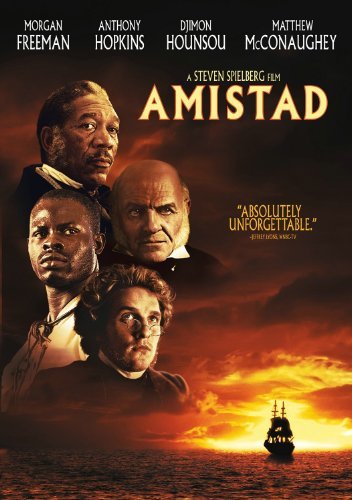
Amistad is the name of a slave ship traveling from Cuba to the U.S. in 1839. It is carrying a cargo of Africans who have been sold into slavery in Cuba, taken on board, and chained in the cargo hold of the ship. As the ship is crossing from Cuba to the U.S., Cinque, who was a tribal leader in Africa, leads a mutiny and takes over the ship. They continue to sail, hoping to find help when they land. Instead, when they reach the United States, they are imprisoned as runaway slaves. They don't speak a word of English, and it seems like they are doomed to die for killing their captors when an abolitionist lawyer decides to take their case, arguing that they were free citizens of another country and not slaves at all. The case finally gets to the Supreme Court, where John Quincy Adams makes an impassioned and eloquent plea for their release.


