
Age: 49
male
Chiwetel Umeadi Ejiofor CBE (/ˈtʃuːətɛlˈɛdʒioʊfɔːr/ CHOO-ə-tel EJ-ee-oh-for; born 10 July 1977) is a British actor. He is the recipient of various accolades, including a British Academy Film Award and a Laurence Olivier Award, in addition to nominations for an Academy Award, two Primetime Emmy Awards, and five Golden Globe Awards. In 2008, he was appointed Officer of the Order of the British Empire (OBE), and in 2015, he was appointed Commander (CBE) for his services to the arts. After enrolling at the National Youth Theatre in 1995 and attending the London Academy of Music and Dramatic Art, at age 19 and three months into his course, Ejiofor was cast by Steven Spielberg to play a supporting role in the film Amistad (1997) as James Covey. He later won the Laurence Olivier Award for Best Actor for Othello (2008). Ejiofor earned the BAFTA Award for Best Actor as well as a nomination for the Academy Award for Best Actor for his portrayal of Solomon Northup in 12 Years a Slave (2013). Ejiofor's other films include Dirty Pretty Things (2002), Love Actually (2003), Kinky Boots (2005), Four Brothers (2005), Children of Men (2006), Endgame (2009), 2012 (2009), Salt (2010), and The Martian (2015). He joined the Marvel Cinematic Universe playing Karl Mordo in Doctor Strange (2016) and Doctor Strange in the Multiverse of Madness (2022). He also voiced Scar in The Lion King (2019). He directed, wrote, and starred in the film The Boy Who Harnessed the Wind (2019). On television, he was nominated for a Primetime Emmy Award for Outstanding Lead Actor for his performance as a jazz band leader in the BBC Two miniseries Dancing on the Edge (2014). He also acted in the BBC drama series The Shadow Line (2011), the HBO television film Phil Spector (2013), and the Showtime science fiction series The Man Who Fell to Earth (2022). Description above from the Wikipedia article Chiwetel Ejiofor, licensed under CC-BY-SA, full list of contributors on Wikipedia.
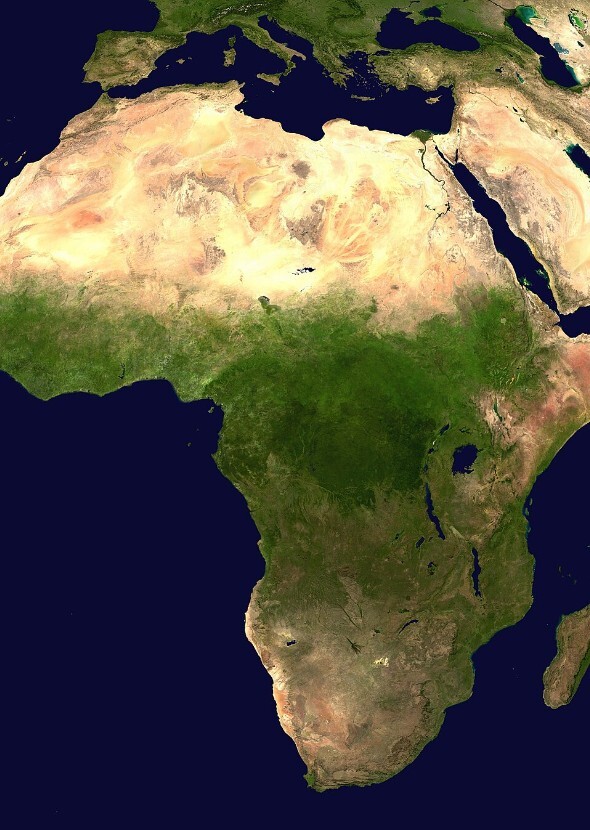
Africa is the world's second-largest and second-most populous continent after Asia. At about 30.3 million km2 (11.7 million square miles) including adjacent islands, it covers 20% of Earth's land area and 6% of its total surface area.[9] With nearly 1.4 billion people as of 2021, it accounts for about 18% of the world's human population. Africa's population is the youngest among all the continents;[10][11] the median age in 2012 was 19.7, when the worldwide median age was 30.4.[12] Based on 2024 projections, Africa's population will exceed 3.8 billion people by 2100.[13] Africa is the least wealthy inhabited continent per capita and second-least wealthy by total wealth, ahead of Oceania. Scholars have attributed this to different factors including geography, climate,[14] corruption,[14] colonialism, the Cold War,[15][16] and neocolonialism. Despite this low concentration of wealth, recent economic expansion and a large and young population make Africa an important economic market in the broader global context, and Africa has a large quantity of natural resources.


