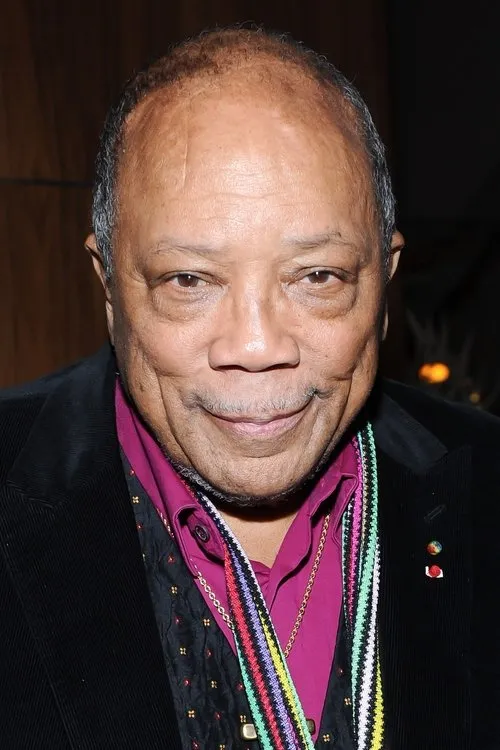
Died at 93
male
Quincy Delight Jones Jr. (March 14, 1933 – November 3, 2024) was an American record producer, musician, songwriter, composer, arranger, and film and television producer. His career spans 70 years in the entertainment industry with a record of 80 Grammy Award nominations, 28 Grammys, and a Grammy Legend Award in 1992. Jones came to prominence in the 1950s as a jazz arranger and conductor before working on pop music and film scores. He moved easily between musical genres, producing Lesley Gore's major pop hits of the early 1960s (including "It's My Party") and serving as an arranger and conductor for several collaborations between the jazz artists Frank Sinatra and Count Basie in the same time period. In 1968, Jones became the first African American to be nominated for an Academy Award for Best Original Song for "The Eyes of Love" from the film Banning. Jones was also nominated for an Academy Award for Best Original Score for his work on the 1967 film In Cold Blood, making him the first African American to be nominated twice in the same year. Jones produced three of popstar Michael Jackson's most successful albums: Off the Wall (1979), Thriller (1982), and Bad (1987). In 1985, Jones produced and conducted the charity song "We Are the World", which raised funds for victims of famine in Ethiopia. In 1971, Jones became the first African American to be the musical director and conductor of the Academy Awards. In 1995, he was the first African American to receive the academy's Jean Hersholt Humanitarian Award. He is tied with sound designer Willie D. Burton as the second most Oscar-nominated African American, with seven nominations each. In 2013, Jones was inducted into the Rock & Roll Hall of Fame as the winner, alongside Lou Adler, of the Ahmet Ertegun Award. He was named one of the most influential jazz musicians of the 20th century by Time.
The setting: the 1960's, Detroit. Estelle, an aspiring Motown singer, wants to make it big but she struggles to get her big break. Norman Mosley, a big Motown singer sees one of her performances in a club and wants her on his future record. They begin to go out and eventually they marry. When she sees a song meant for Norman, "I'm Nothin' When You're Gone", she wants to make it a duet. Norman stands his grounds and demands he wrote it for him to sing. Later, the record label unemploys him and the song goes to Estelle. The single is the #1 at the Billboards Chart, and her fame sky-rockets. Norman sees her success from the sidelines as he becomes addicted to drugs and alcohol. This leads to some conflict between them, including the fact that Estelle is now pregnant with Norman's child. Estelle eventually wins a grammy, but Norman interrupts the event by stumbling on stage and drunkenly shouts at Estelle about how she ruined him and yells at the camera as he passes out. Estelle is distressed and offers to pay his stay at a rehab center. He can't stand the idea of being supported by someone who "stole" his job, and he commits suicide. Estelle performs the single he wrote, "I'm Nothin' When You're Gone" for the last time before quitting and focusing on her life as a new mother.


