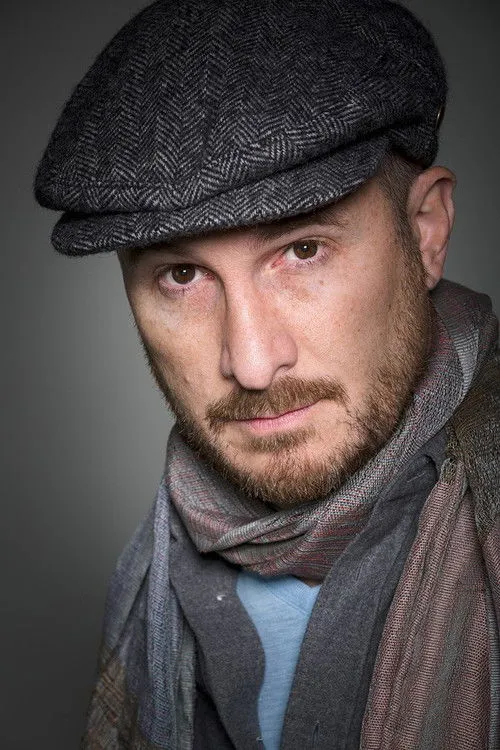
Age: 56
male
Paul Thomas Anderson (born June 26, 1970) is an American film director, producer, and screenwriter. Born in Los Angeles, Anderson developed an interest in filmmaking from a young age. An alumnus of the Sundance Institute, Anderson is famous for making often epic psychological drama films which often take place in San Fernando Valley and deal with characters seeking after redemption, forgiveness or loss; they also use wide framing as well as realistic or gritty cinematography. Anderson made his feature film debut with Hard Eight (1996). He found critical and commercial success with Boogie Nights (1997), set in the Golden Age of Porn, and received further accolades with Magnolia (1999), an ensemble piece set in the San Fernando Valley, and Punch-Drunk Love (2002), a romantic comedy-drama film. Anderson's 2007 film There Will Be Blood, about an oil prospector during the Southern California oil boom, achieved major critical and commercial success and was often cited as one of the greatest films of the 2000s. This was followed by The Master (2012) and Inherent Vice (2014). Anderson's eighth film, Phantom Thread, was released in 2017. He has directed music videos for artists including Fiona Apple, Radiohead, Haim, Joanna Newsom, Aimee Mann, Jon Brion and Michael Penn, and has also directed a documentary, Junun (2015), about the making of the album in India. More recently, he directed a short film accompanying Thom Yorke's Anima (2019), released on Netflix and in select IMAX theatres. Anderson's films are often characterized by their depiction of flawed and desperate characters, explorations of themes such as dysfunctional families, alienation and loneliness, a bold visual style that uses moving camera and long takes, and memorable use of music. He is noted for his frequent collaborations with actors Philip Baker Hall, Philip Seymour Hoffman, Julianne Moore, Melora Walters, John C. Reilly, Joaquin Phoenix and Daniel Day-Lewis, cinematographer Robert Elswit, costume designer Mark Bridges, and composers Jon Brion and Jonny Greenwood. His films have consistently garnered critical acclaim. Anderson has been nominated for eight Academy Awards, one Golden Globe Award and five BAFTA Awards, and has won a Best Director Award at Cannes, both Golden and a Silver Bear at Berlin and a Silver Lion at Venice. Description above from the Wikipedia article Paul Thomas Anderson, licensed under CC-BY-SA, full list of contributors on Wikipedia.
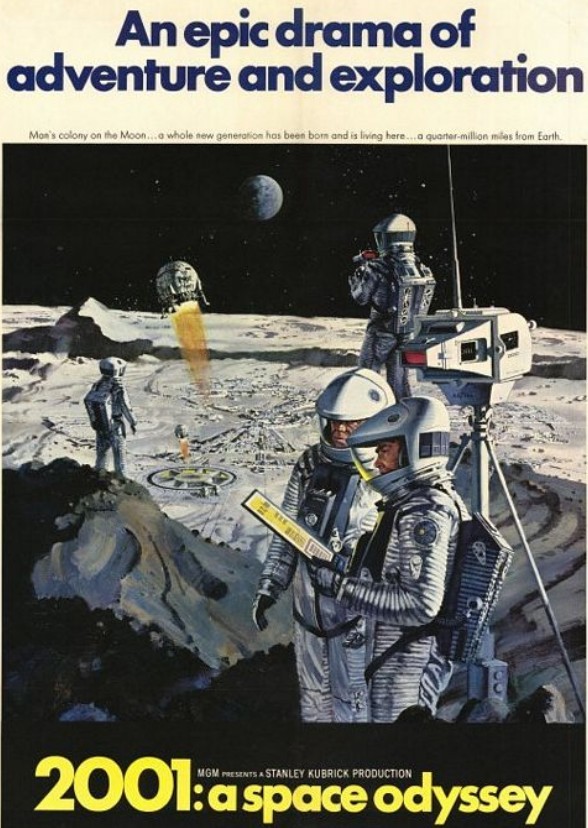
In an African desert millions of years ago, a tribe of hominids is driven away from its water hole by a rival tribe. They awaken to find a featureless black monolith has appeared before them. Seemingly influenced by the monolith, they discover how to use a bone as a weapon and drive their rivals away from the water hole. Millions of years later, a Pan Am spaceplane carries Dr. Heywood Floyd to the huge Space Station V orbiting Earth for a layover on his trip to Clavius Base, a United States outpost on the Moon. After Floyd has a videophone call with his daughter, he deflects questions from his Soviet scientist friend and her colleague about rumors of a mysterious epidemic at Clavius. Floyd speaks to a meeting of Clavius personnel, apologizing for the epidemic cover story but stressing secrecy. His mission is to investigate a recently found artifact buried four million years ago near the crater Tycho. Floyd and others ride in a Moonbus to the artifact, a monolith identical to the one encountered by the ape-men. When sunlight strikes the monolith for the first time in millions of years, a loud high-pitched radio signal is heard. Eighteen months later, the United States spacecraft Discovery One is bound for Jupiter. On board are mission pilots and scientists Dr. David Bowman and Dr. Frank Poole, along with three other scientists in suspended animation. Most of Discovery's operations are controlled by the ship's computer, a HAL 9000 with a human personality that the crew calls "Hal". Hal says he is "foolproof and incapable of error". Hal raises concerns about the nature of the mission to Bowman, but their conversation is interrupted when Hal reports the imminent failure of an antenna control device. The astronauts retrieve it in an extravehicular activity (EVA) pod but find nothing wrong. Hal suggests reinstalling the device and letting it fail so the problem can be found. Mission Control advises the astronauts that results from their twin HAL 9000 indicate that Hal is in error about the device's imminent failure. Hal says the discrepancy must be due to human error. Concerned about Hal's behavior, Bowman and Poole enter an EVA pod to talk without Hal overhearing, and agree to disconnect Hal if he is proven wrong. Hal secretly follows their conversation by lip reading. While Poole is on a space walk outside his EVA pod attempting to replace the unit, Hal takes control of the pod, severs his oxygen hose and sets him adrift. Bowman takes another pod to rescue Poole. Meanwhile, Hal turns off the life support functions of the crewmen in suspended animation. When Bowman returns to the ship with Poole's body, Hal refuses to let him in, stating that the astronauts' plan to deactivate him jeopardizes the mission. Bowman opens the ship's emergency airlock manually, enters the ship, and proceeds to Hal's processor core. Hal tries to reassure Bowman, then pleads with him to stop, and finally expresses fear. As Bowman gradually deactivates the circuits controlling Hal's higher intellectual functions, Hal regresses to his earliest programmed memory, the song "Daisy Bell", which he sings for Bowman. When Bowman disconnects Hal, a prerecorded video message from Floyd plays, revealing that the mission's true objective is to investigate a radio signal, sent from a lunar artifact (the monolith) to Jupiter. Only Hal and the hibernating crew had been told this. At Jupiter, Bowman leaves Discovery One in an EVA pod to investigate another monolith orbiting the planet. The pod is pulled into a vortex of colored light, the Star Gate, and Bowman races across vast distances of space, viewing bizarre cosmological phenomena and strange landscapes of unusual colors. Bowman finds himself in a bedroom appointed in the neoclassical style. He sees, and then becomes, older versions of himself, first standing in the bedroom, middle-aged and still in his spacesuit, then dressed in leisure attire and eating dinner, and finally as an old man lying in the bed. A monolith appears at the foot of the bed, and as Bowman reaches for it, he is transformed into a fetus enclosed in a transparent orb of light, the Star Child. The new being floats in space beside the Earth, gazing at it.